
AI4EAFRoute

Artificial Intelligence supporting innovative EAF Route methods for process and plant management to enhance performance and component effectiveness
AI4EAFROute project aims to enhance the performance, reliability, and sustainability of the Electric Arc Furnace (EAF) route by integrating advanced monitoring technologies with artificial intelligence (AI) tools. Through four targeted use cases, the project will tackle key process challenges, including scrap melting management, optimization of electrical parameters, refractory lining erosion, water leakage in panels, event recognition and prediction, and overall performance management. For each use case, dedicated AI models will be developed using real industrial data and leveraging multimodal inputs such as acoustic, volumetric, visual, and thermal signals.


The approach followed will include the monitoring and data analysis of equipment status in parallel with the typical approach used for process monitoring and management, in order to study the influence of the adopted operating practices on equipment condition and durability, and to evaluate the impact of component ineffectiveness on process performance. Both evaluations will be translated into simplified prediction rules, to be used also as part of the guidelines for a Decision Support System (DSS).
These models will be integrated into an advanced AI-based DSS, designed to provide furnace operators with real-time recommendations. This will enable more precise process control, reduced unplanned maintenance, extended equipment lifetime, and significant cost and energy savings.
The project advances the state of the art on several fronts. In Computer Vision, it will introduce novel techniques for robust image analysis under the harsh conditions of EAF environments. In time-series analysis, it will apply advanced AI methods to acoustic signal patterns, enabling the early detection of inefficiencies and failures. By combining these innovations, the project will deliver a holistic and predictive approach to EAF management that is not currently available on the market.
Ultimately, the project will strengthen both the decarbonization and the competitiveness of the European steel industry by optimizing EAF processes and management. In doing so, it directly supports the objectives of the RFCS program and the European Green Deal, through improved resource efficiency, higher metallic yield, and reduced CO₂ emissions.
Methodology
To evaluate the industrial, operational, and environmental benefits of the AI4EAFRoute solutions, a structured scenario-based methodology will be applied. The analysis will compare current EAF operations (baseline scenario) with the AI-assisted operation enabled by the technologies developed within the project. The assessment will be based on industrial data collected during the demonstration activities and on the outputs generated by the AI models and the Decision Support System (DSS).
Scenario 1: Scrap Melting Management Performance Assessment
The first scenario focuses on the impact of the AI-based Scrap Melting Management solution. Historical and real-time process data, including scrap volume and density measurements, scrap classification results, acoustic signals, electrical parameters, and melting progression indicators, will be analysed. The AI predictions will be compared with conventional charging practices to quantify improvements in melting efficiency, charging timing, power-on time, metallic yield, and energy consumption. Statistical analysis will be performed to evaluate the robustness of the recommendations generated by the DSS under different scrap mix and operational conditions.
Scenario 3: Components, Events Management and Plant Reliability Assessment
The third scenario investigates the influence of AI-supported monitoring of refractory lining, electrodes, cooling panels, and critical event detection on plant reliability and maintenance performance. Data acquired from local cameras, acoustic and vibration sensors, thermal monitoring systems, maintenance records, and event logs will be integrated to evaluate the predictive capabilities of the developed models. The analysis will quantify reductions in unplanned downtime, improvements in maintenance scheduling, extension of component lifetime, and enhancement of operational safety resulting from the early identification of abnormal conditions such as refractory degradation, water leakage, scrap collapse, and flame-out events.
Scenario 2: Electrical Management and Energy Efficiency Assessment
The second scenario evaluates the benefits associated with the Arc Quality Index (AQI) and the AI-driven Electrical Management model. High-frequency electrical data, electrode position measurements, process parameters, and energy consumption records will be analysed to assess the effectiveness of optimized transformer tap settings, arc stability management, and slag coverage recommendations. The comparison between conventional operation and AI-supported operation will quantify improvements in electrical efficiency, energy transfer effectiveness, arc stability, power consumption, and process consistency.
Scenario 4: Global Performance and Sustainability Assessment
The fourth scenario provides an integrated assessment of the overall impact of the AI4EAFRoute framework. By combining process data, equipment condition indicators, maintenance information, and DSS recommendations, the analysis will evaluate global furnace performance under AI-assisted management. Technical, economic, and environmental indicators will be considered, including productivity, tap-to-tap time, metallic yield, energy consumption, maintenance costs, plant availability, and CO₂ emissions. Environmental benefits will be quantified using a comparative approach between baseline and optimized operation, enabling the estimation of direct and indirect emission reductions associated with improved process efficiency and reduced resource consumption.
Overall, the four scenarios will provide a comprehensive validation of the AI4EAFRoute technologies, demonstrating their technical feasibility, industrial applicability, economic benefits, and contribution to the decarbonisation and digitalisation of the European steel industry.
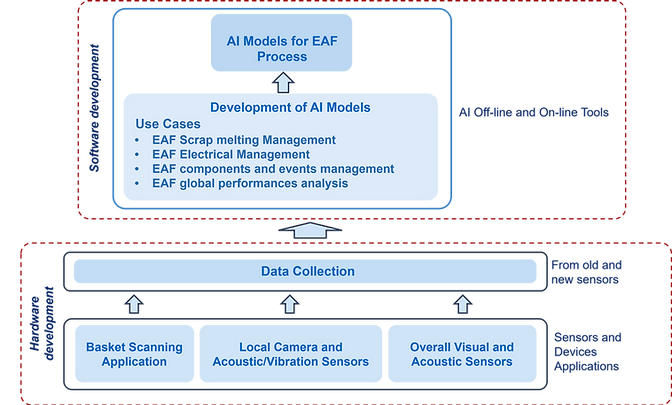
The process begins with “data collection” through both existing and newly deployed sensors and applications (“Basket Scanning Application”, “local camera and Acoustic/Vibration Sensors” and “Overall Visual and Acoustic Sensors”). These data streams feed the “development of AI models” focused on “scrap melting management”, “electrical management”, “components and event management”, and “global performance analysis”. The resulting models support both offline tools for operational optimization and online Decision Support Systems to enhance process performance. This integrated approach enables improved efficiency, reliability, and process control across the different application scenarios.

Main modules developed in the Ai4EAFRoute project